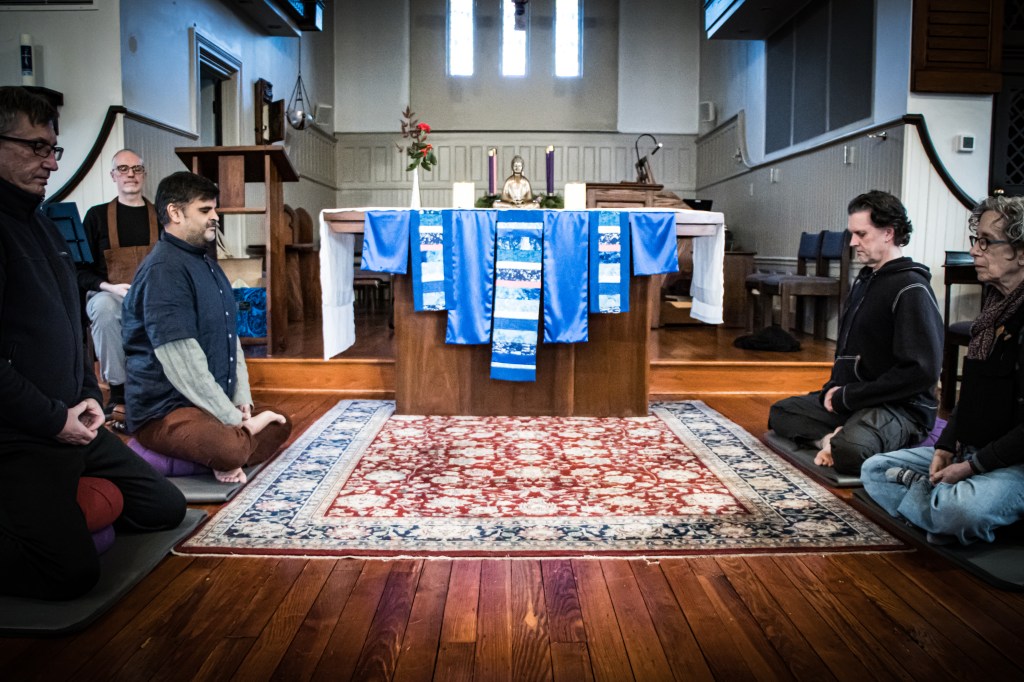
Cushions, mats, chairs, and pews available. If you have a meditation cushion you prefer, feel free to bring it.
Our Liturgy and Chants
Click for a downloadable PDF of our Liturgy and Chants. It includes our versions of the Three Refuges, the Four Great Bodhisattva Vows, the Gatha on Opening the Sutras, the Heart Sutra, the Four Brahmavihārā, and the Great Admonition that we chant during the sit.
Our Order of Practice
Click for a downloadable PDF of our order of practice. It details what we do and in what order.
Hear the Heart Sutra chanted in English
Click for a recording on YouTube. (Our intonations differ somewhat.)
Why We Bow to the Buddha—Won-myong Sunim
Whenever anyone goes to a Buddhist temple he bows to the Buddha in the Main Hall. Visitors who do not know much about Buddhism think that the people are worshiping idols, that they are bowing to a statue of metal, wood or stone. This is wrong!
Buddhists make and keep statues as reminders. They do not worship the material that the statue is made of. They do not bow to the substance used by the artist to create that inspiring object. They bow in remembrance of the Buddha’s qualities and teachings. They bow out of gratitude for the Buddha’s great kindness in teaching us. They bow to themselves and to all living beings for each and every one has Buddha Nature – the potential for enlightenment ‑ within: each one is a Buddha.
The Buddha did not teach in order to save us; he taught that we are already saved. Everybody has eternal life and infinite, limitless capacity. So we do not bow because there is an object of wood or stone, we bow to ourselves and look at ourselves as if in a mirror.
Master Chao Chou said:
A gold Buddha cannot pass through a furnace.
A mud Buddha cannot pass through water.
A wood Buddha cannot pass though fire.
In this way the real Buddha doesn’t depend on the material. It depends on our own nature, for Buddha is everywhere. Through the Buddha statue we see ourselves….
(source)
Why We Chant [and Bow]—from Dropping Ashes on the Buddha by Zen Master Seung Sahn
Everybody has different karma. So all people have different situations, different conditions, and different opinions. One person is a monk, another is a student, another works in a factory; one person always keeps a clear mind, another is often troubled or dissatisfied; one person likes the women’s movement, another doesn’t. But everybody thinks, ‘My opinion is correct!’ Even Zen Masters are like this. Ten Zen Masters will have ten different ways of teaching, and each Zen Master will think that his way is the best. Americans have an American opinion; Orientals have an Oriental opinion. Different opinions result in different actions, which make different karma. So when you hold on to your own opinions, it is very difficult to control your karma, and your life will remain difficult. Your wrong opinions continue, so your bad karma continues. But at our Zen Centers, we live together and practice together, and all of us abide by the Temple Rules….
So we live together and act together. Acting together means cutting off my opinions, cutting off my condition, cutting off my situation. Then we become empty mind. We return to white paper. Then our true opinion, our true condition, our true situation will appear. When we bow together and chant together and eat together, our minds become one mind. It is like on the sea. When the wind comes, there are many waves. When the wind dies down, the waves become smaller. When the wind stops, the water becomes a mirror, in which everything is reflected—mountains, trees, clouds. Our mind is the same. When we have many desires and many opinions, there are many big waves. But after we sit Zen and act together for some time, our opinions and desires disappear. The waves become smaller and smaller. Then our mind is like a clear mirror, and everything we see or hear or smell or taste or touch or think is the truth. Then it is very easy to understand other people’s minds. Their minds are reflected in my mind.
So chanting is very important. At first you won’t understand. But after you chant regularly, you will understand. ‘Ah, chanting—very good feeling!’ It is the same with bowing 108 times. At first people don’t like this. Why do we bow? We are not bowing to Buddha, we are bowing to ourselves. Small I is bowing to Big I. Then Small I disappears and becomes Big I. This is true bowing. So come practice with us. You will soon understand.
 Scudder Falls Zen